Sunday, February 20, 2011

Iris Abellana and Team Building Facilitation, Cebu, Philippines

Sustainable Professions and People who make a difference in Cebu

Long before team building games became popular,
Iris Abellana has been crafting ways to torture participants
to crack their brains to think, solve problems creatively and work together.

She has facilitated with us for many years
in our company leadership trainings,
outdoor team building races,
and family reunions.

Thank you Teacher Iris,
for helping us build our communities
through zany games and outrageous challenges.

teacher iris in action


facilitating a family reunion

coordination and manual dexterity test

iq test


salamat

Dominic Asio/Madhu, Artist, Cebu, Philippines

Sustainable Professions and People who make a difference in Cebu

Madhu is a drummer,
drum maker, drum circle facilitator,
indigenous musician, and crafts teacher.

Madhu is a patient teacher.
He introduced us to the agong and the kuping.
He taught us how to  play the drums.
He showed us  how to make dreamcatchers.

Thanks Madhu for sharing your energy and talents
at KPAF Katunggan Permaculture Adventure Farm, Cebu.

madhu in action

oldest students

learners in action

madhu at kpaf eco pavilion

join na

Saturday, February 19, 2011

Cecile Villarente/ Savitri and Music Workshop Facilitation in Cebu, Philippines

Sustainable Professions and People who make a difference in Cebu

We all love music.
We do not have to be a musician to enjoy music,
but many of us are shy to sing or dance in public.
Most of us will try to  find a dark corner to hide
or  we find some excuse in order not to participate
 in any event that will somehow call forth for an exhibition of our musical ability.

In most countries, they have all year music workshop events
held at community centers and schools.
They are offered to infants, school children, adults and even the elderly.
These events are often funded by the local government,
an art foundation or the national arts council.
These workshops are facilitated by excellent musicians
who are also trained in group facilitation.

Here in the Philippines and Cebu in particular
we hardly have any opportunities to join music workshops
They are either focused solely on highly skilled musicians or given to a select few.

Where can we,
the rest of the people in the normal curve go for a music workshop?
Well, we have a person to call on, who can conduct it anywhere...
Cecil Villarente or Savitri ,
has been giving music workshops
at different towns and events to a diverse group of participants.
She facilitates community singing and dancing.

Lots of fun...
Salamat Savitri!!!


savitri in action at KPAF
Katunggan Permaculture Adventure Farm
everybody gets to join

loads of fun

Bob Bajenting and Natural Farming in Cebu, Philippines

Sustainable Professions and People who make a difference in Cebu

The vegetables we eat are all laced with harmful pesticides.
Are we going to be forever captives of these pesticide companies?
Are we just going to sit and shove down these poisonous foods down our mouths?
Picture this, the mouths of our newborn infants,  cancer patients,
and those suffering from all kinds of newly emerging diseases.

We all know that we cannot do this to our loved ones...
There is a way to combat this global pandemic.
Grow your own food!
We can do it.
We need  to have
the will to  REFUSE,
the industry to get access to the correct information,
an openess to try out non-traditional methods,
and the persistence to carry out what may appear to be tedious...

In Cebu, yes, we can grow our own food...
Bob Bajenting has been freely and openly sharing
his wealth of experience in natural farming.

What is natural farming?
It is also called sustainable farming,
all inputs to the soil comes from natural materials.
Inputs come in the form of fruits, fish products, organic waste, etc

Sir Bob is the man leading this revolution in Cebu. Thanks for sharing with us.
Part of our companies' CSR- Corporate Social Responsibility is Cultivating Self-Reliance.
We teach them how to grow their own food using natural farming inputs.


Sir Bob doing a Natural Farming Training at the Loft of Elicon House

Sir Bob doing his natural farming presentation

teaching our staff how to prepare fermented fruit inputs

standardized measures

everybody is busy learning by doing

Raul Amores and Beekeeping in Cebu, Philippines

Sustainable Professions and People who make a difference in Cebu

Beekeeping or apiculture is the maintenance  of hives  or bee colonies in order to collect honey, beeswax, to produce other bees or keep them in order to pollinate crops. A beekeeper or apiarist is the person who maintains these bee hives or colonies.

Beekeeping in Cebu has been possible because there are beekeepers like Raul Amores who willingly share their knowledge and love for bees. Our bees in Cebu at KPAF (Katunggan Permaculture Adventure Farm) and KGZ (Kamagayan Green Zone- An Urban Permaculture Project) were set up with the kind guidance of Raul. We are very proud to say that our bees have shared their  honey with us and our friends. Last Christmas our bees joined in the Christmas spirit of sharing.

Our bees help us grow our own sugar. Thanks Raul for sharing your invaluable patience and support.


Thursday, February 17, 2011

The Heritage Tree of Canlaon, Negros Oriental

What is a heritage tree?

It is a tree designated by the local or national government
as a protected tree because of its historic or natural significance.
In most cities around the world,
any tree that has a minimum trunk  diameter of 15 inches
or circumference of 45 inches ;
is an endemic or native species,
and lastly, has a special character,
an important historical or community significance,
is considered a heritage tree and must be protected.

Therefore heritage trees
are legally protected and property of the province or country.
These trees are to be protected and maintained in a good state of health.
In most countries, these trees are under the care of the city arborist.
In other places, they form heritage societies
whose sole purpose is the care, maintenance
and protection of these heritage trees.

In Kanlaon City,
there is a Balete tree that is  said to be 1,328 years old
(according to the provincial government).
It stands in the middle of the rice and coffee plantation
of OISCA Farm in Lumabao, Canlaon City.
It is said to be the oldest tree in Negros Oriental
and perhaps also of the Philippines.
At night, it appears to be illuminated
because of the thousands of fireflies that take refuge in its crown.
Thus, the locals think that the tree is enchanted
and  inhabited by fairies that have special powers
that they use to the maximum when provoked.
Maybe it is the reason why the locals
have restrained themselves from chopping it down.


Local children, lovers, and teens love to climb this majestic tree.
It has also become a major tourist attraction in the city.
This tree has long and sturdy roots,
with large and spreading branches for a crown.
We loved climbing this tree.


The national and local government in the Philippines
seem to  have not yet come to the awareness of the concept of heritage trees,
as they think of this tree only as  a tourist attraction.
But, it is more than a tourist attraction.

If the government has not taken action, I will.

It meets all the criteria of a heritage tree.
The trunk diameter of the tree is way more than the 15 inches minimum.
It is old and has witnessed the history of Canalon City.
It gives playful joy to the locals and visitors.
It  has a special character
because it is a natural  habitat to thousands of fireflies and other wildlife.
It is also the home of the most respected
and everlasting residents of the area- the powerful tree fairies.

I therefore baptize it
as the Heritage Tree of Canlaon,
in the name of the birds,
the fireflies,
the fairies and the people who climb it
and breathe the oxygen it emits.

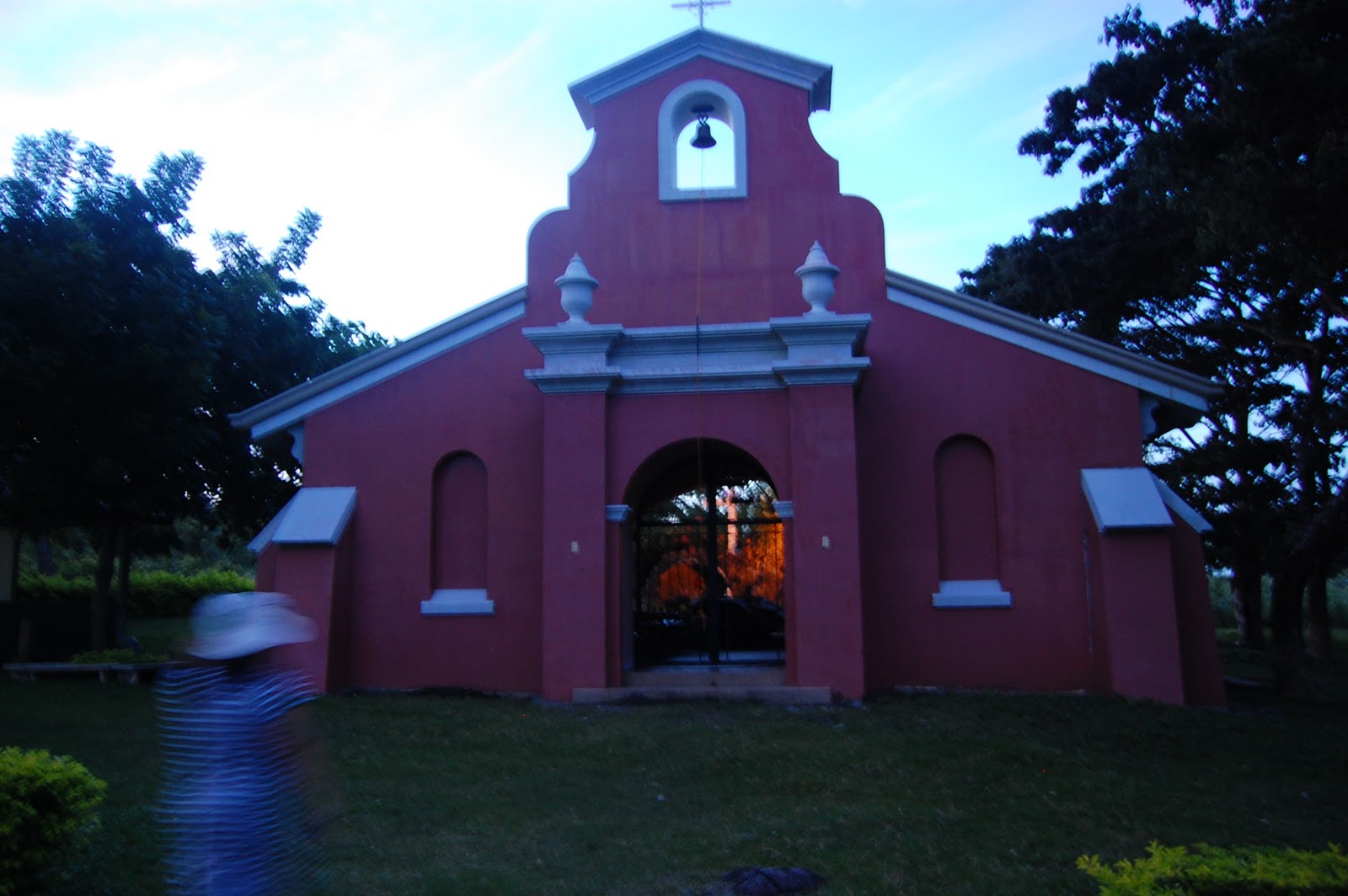
Capilla sa Cambaloctot, San Jose, Negros Oriental

On the way to Lake Balinsasayao, there is a beautiful chapel with an outdoor altar/grotto. The chapel was built to celebrate the "miracle of the dancing sun" as witnessed on that site by a medical team from the Armed Forces of the Philippines Dumaguete on March 4, 1989. The team was doing volunteer civic action work in Barangay Cambaloctot.

Spanish inspired architecture

the interior of the chapel

the outdoor grotto and altar

view of the sea from the chapel